Why Do I Leak When I Sneeze or Jump in Perimenopause (And What Actually Fixes It)?

Why Do I Leak When I Sneeze or Jump in Perimenopause (And What Actually Fixes It)?
You leak when you sneeze, cough, jump or run because the muscles that keep your bladder closed are not producing enough force at the exact moment the pressure spikes. Falling oestrogen makes that harder. The tissue around the bladder neck thins, the support underneath becomes less springy, and a pelvic floor that coped perfectly well at 32 stops coping at 47. That is the mechanism. It is not a punishment for having children 20 years ago, and it is not a window you missed.
Here is the part almost nobody tells women: this responds to training. Pelvic floor muscle training is the first line treatment recommended by NICE in the UK, and the reviews published in 2024 and 2025 keep landing in the same place. Most women improve. A good number stop leaking altogether. It takes around 3 months of doing it properly, which is roughly how long it takes to get stronger anywhere else in your body. Your pelvic floor is skeletal muscle. It follows the same rules as your glutes.
Key Takeaways
- Leaking on impact is driven by falling oestrogen and an undertrained muscle, not by age alone.
- Pelvic floor dysfunction affects roughly 40 to 50% of postmenopausal women, and about 1 in 3 women leak during exercise.
- NICE recommends at least 3 months of supervised pelvic floor muscle training as the first thing to try, at a dose of at least 8 contractions, 3 times a day.
- Reviews published in 2024 and 2025 found improvement in almost every trial of pelvic floor training in postmenopausal women.
- Avoiding exercise to avoid leaking costs you muscle, bone and energy, and does nothing for the leaking.
The bit nobody explains at the 10 minute appointment
Your pelvic floor is a sling of muscle running from your pubic bone to your tailbone. It carries your bladder, bowel and uterus, and its main job is to stay shut when the pressure inside your abdomen goes up. Every sneeze, cough, laugh, jump and heavy lift sends that pressure surging downwards. A trained pelvic floor meets it. An untrained one lets a little through.
Two things change in perimenopause, and they stack.
The first is tissue. The urethra, bladder neck and surrounding tissues are rich in oestrogen receptors. As oestrogen falls, those tissues become thinner and less elastic, and the seal that keeps everything closed becomes less reliable. This is the same underlying change that causes vaginal dryness and recurrent urinary tract infections in midlife, which is why they so often turn up together.
The second is the muscle itself. Pelvic floor muscle loses strength and, more importantly, speed. Speed is the part that gets missed. A sneeze spikes abdominal pressure in a fraction of a second. If your pelvic floor contracts even a moment late, you leak. Training slow, held squeezes trains only half of what you actually need.
There is a third thing, and it is the one I see most often as a trainer. The load has changed. A lot of women reach their mid 40s, notice their body fat redistributing, and respond by adding running, classes, skipping or high intensity intervals. Those are exactly the activities that expose an untrained pelvic floor. She thinks the exercise caused the problem. It did not. It revealed it.
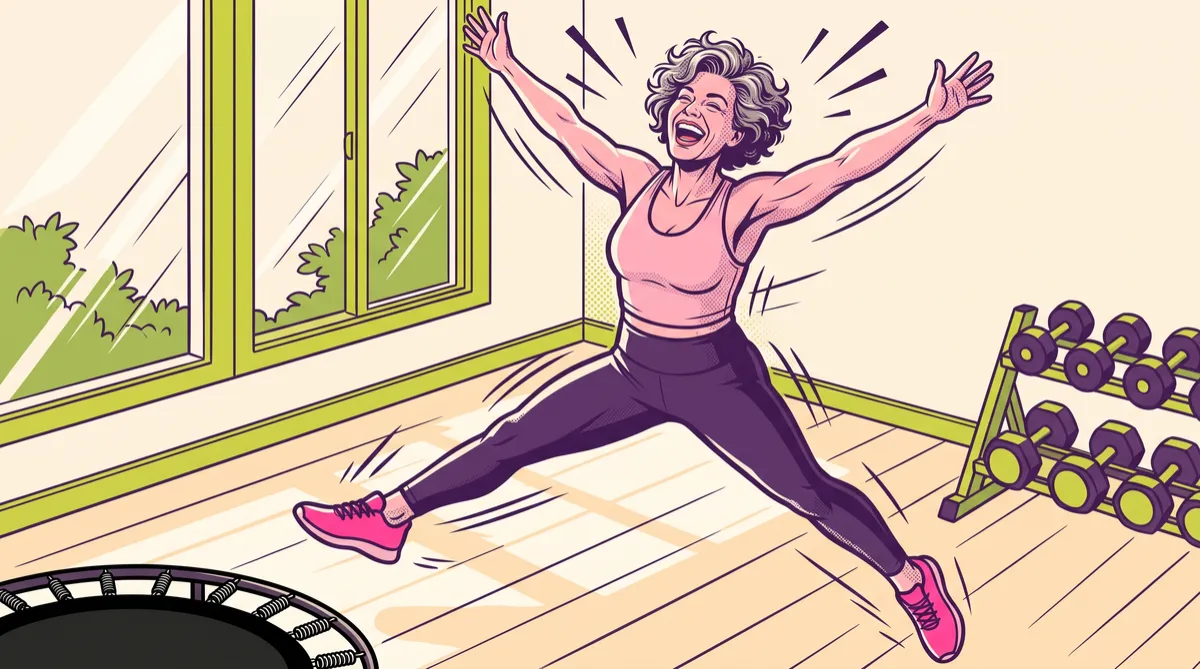
Then comes the quiet part. She stops jumping in class. She goes to the loo before she leaves the house, then again before she gets in the car. She wears black. She skips the trampoline park with the grandchildren. She stops running. Nobody sees any of this, because she never says it out loud, and she files the whole thing under getting older.
That is the real cost. Not the leaking. The shrinking.
What the research actually says
A 2025 paper published in JMIR mHealth and uHealth put the prevalence of pelvic floor dysfunction in postmenopausal women at roughly 40 to 50%. That figure covers urinary and bowel leakage, pelvic pain and prolapse. It is not a rare complaint. It is closer to a coin toss.
A large observational study of 1,446 women, published in BMC Public Health in 2023, found urinary incontinence in 55.8% of the women studied, with menopausal status and increasing age both raising the odds. Again, this is not unusual. It is normal in the statistical sense, which is a very different thing from normal in the sense of something you have to accept.
Now the exercise piece, because this is my lane. Research into physically active women has found that leakage changes what women do, not just how they feel. Around half of active women who leak report that it affects their activity level. Of those, over 90% reduce the intensity of what they do, and over 80% avoid specific activities altogether. Roughly 1 in 3 women leak during exercise at all, and among female runners the figure has been reported as high as 44%. Skipping, trampolining, star jumps and running are the usual culprits.
Read that again. Over 90% of women who leak during exercise train less hard because of it. In midlife. At the exact point when muscle and bone need loading more than at any previous stage of life. That is the trade nobody agreed to.
Here is the encouraging half.
A systematic review published in 2025 in the Journal of Clinical Medicine looked at training interventions aimed at improving pelvic floor function in postmenopausal women specifically. Of the 15 studies analysed, 14 showed improvement in pelvic floor muscle function related to continence. That is 14 out of 15.
A 2024 meta-analysis in the European Journal of Obstetrics and Gynecology and Reproductive Biology reached the same conclusion for postmenopausal women: pelvic floor muscle training improves urinary incontinence symptoms.
A Cochrane review updated in 2024 compared different approaches to pelvic floor training and found that supervision matters. Women who are taught the contraction properly and reviewed while they train do better than women handed a leaflet and left to it.
And a randomised trial published in 2024 compared Pilates with conventional pelvic floor training in postmenopausal women. It found no meaningful difference between them, provided the women were performing a genuine voluntary pelvic floor contraction. That last clause is the whole story. The label on the class matters far less than whether the right muscle is actually working.
Which brings me to the most useful finding in this whole field, and it is decades old. A significant proportion of women cannot produce a correct pelvic floor contraction from written or verbal instruction alone. Some bear down instead of lifting. Some squeeze their glutes. Some hold their breath and brace their abdomen. They then do their exercises diligently for months, get nowhere, and conclude that their body is beyond help.
Their body was fine. The instruction was rubbish.
What to do about it, in order
First, get assessed properly. A pelvic health physiotherapist can tell you in one appointment whether you are contracting correctly, whether you are gripping too much (an overactive pelvic floor leaks too, and squeezing harder makes it worse), and whether anything else is going on. In many parts of the UK you can self refer without going through your GP. If you take one thing from this article, take that. Everything else works better once you know what you are actually training.
Second, train both speeds. Long holds build endurance. Quick, sharp contractions build the speed you need for a sneeze. Most women do only the first. NICE recommends a programme of at least 8 contractions performed 3 times a day, sustained for at least 3 months. Set a phone reminder and attach it to something you already do. Kettle on, 8 contractions. That is the kind of habit that survives a bad week.
Third, learn the knack. Contract your pelvic floor deliberately just before you sneeze, cough, laugh or pick up something heavy. It sounds too simple to matter. It matters. It gives you immediate control while the strength work catches up in the background.
Fourth, do not stop strength training. This is where I get emphatic. Squats, deadlifts, split squats and carries, done with reasonable technique and sensible load, are good for your pelvic floor, not bad for it. What often needs adjusting temporarily is impact, not resistance. Swap skipping for step ups. Swap running for hill walking or the bike. Keep lifting. You need that muscle and you need that bone.
Fifth, sort out what raises the pressure. Chronic constipation and straining put your pelvic floor under load several times a day, every day. Fibre, water and not sitting on the loo scrolling for 15 minutes all help more than they should.
Sixth, have the conversation about local oestrogen. For a lot of women, vaginal oestrogen makes a substantial difference to the tissue side of this, and it works alongside the training rather than instead of it. That is a conversation for your GP or a menopause specialist, and the British Menopause Society has good patient information if you want to walk in prepared. It is not my lane, but it belongs on your list.
Seventh, give it 3 months before you judge it. Muscle is muscle. You would not expect visible change in your legs after 2 weeks of squats. Apply the same patience here, and track something concrete: pads used, times you leaked this week, whether you managed the star jumps.
Common questions
Is leaking just a normal part of getting older?
It is common, which is not the same as inevitable or untreatable. Roughly half of postmenopausal women deal with some form of pelvic floor dysfunction, and the evidence from 2024 and 2025 is that most of them improve with proper training. Common and permanent are 2 different words, and the fitness industry has been muddling them for years.
How long before I notice a difference?
NICE recommends judging a training programme over at least 3 months. Many women notice something sooner than that, usually a reduction in how much leaks rather than it stopping outright. The mistake is stopping at 4 weeks because nothing dramatic has happened. That is precisely the point at which most strength adaptations are just getting going.
Should I stop running or jumping until it improves?
Not necessarily, and please do not stop training altogether. Reduce impact temporarily if you need to, keep the resistance work, and add the pelvic floor training alongside. The women who quit exercise because of leaking end up losing muscle, bone density and energy, and the leaking does not improve on its own. That is the worst of both outcomes.
Do I really need a physiotherapist, or can I do this on my own?
You can absolutely make progress on your own. You will make faster and more reliable progress if someone confirms you are contracting the right muscle in the right direction, because a large number of women are not, and no amount of diligence fixes a contraction that is going the wrong way. The Cochrane evidence backs supervision. Think of it as one or 2 appointments to get the technique right, then the work is yours.
Does Body Reclaim cover this?
Honestly, partly. Body Reclaim is a 12 week program for women in midlife built around energy, strength and nutrition, in the right order at the right time. It will build the strength, the protein intake and the training habits that support your pelvic floor, and it will teach you how to train in a way that does not make leaking worse. It is not a pelvic health rehabilitation program, and I would never pretend otherwise. That specific work belongs with a pelvic health physiotherapist, and the 2 sit very comfortably side by side. Join the waitlist to be notified when the next intake opens.
Before you go
I am 55. I have spent years in gyms, and I can tell you that the number of women who quietly stop doing something because of this is far higher than anyone admits. They do not tell their friends. They do not tell their trainer. They tell themselves it is just what happens now, and they get a little smaller in the world every year.
You did not lose the trampoline. You just stopped asking for it back.
Get it assessed. Train the muscle. Keep lifting. Give it 3 months and see what your body does with a bit of accurate information for once, instead of another leaflet and a shrug.
Join the waitlist to be notified when the next Body Reclaim enrolment opens.
Jane Cox is a personal trainer and menopause specialist based in Bournemouth, and the creator of Body Reclaim, a 12 week program for women over 40 built on The Compound Method™. She has spent years working with women in midlife, and went through her own perimenopause first. This article is general fitness and lifestyle information and is not a substitute for individual medical advice.