Why Does Fat Build Up in My Liver in Perimenopause (And Why Does Nobody Test For It)?
Programs Testimonials Shop About Contact
Why Does Fat Build Up in My Liver in Perimenopause (And Why Does Nobody Test For It)?
Fat builds up in your liver in perimenopause because oestrogen was quietly doing a job in there that nobody told you about. Oestrogen helps decide how much fat your liver makes, how much it stores and how much it sends back out. When oestrogen starts dropping in your 40s, that system stops running the way it did, and fat begins collecting inside the liver cells themselves. The condition has a name now. It is called MASLD, metabolic dysfunction-associated steatotic liver disease. You might know the old name, non-alcoholic fatty liver disease.
Nobody tests for it because it does not hurt. There is no symptom to report and nothing to point at. Standard liver blood tests frequently come back normal even when there is a real amount of fat sitting in the liver, so a clear result from your GP is not the same as a clear liver. Most women find out by accident, on a scan for something completely unrelated, often years after it started.
Key Takeaways
MASLD prevalence rises from around 9% to 18% in premenopausal women to over 30% in peri and postmenopausal women, tracking the fall in oestrogen.
A meta-analysis put the odds of fatty liver at 2.37 times higher after menopause compared with before it.
Normal liver blood tests do not rule it out. A normal ALT on its own proves very little.
Slim women are not exempt. A 2024 cohort found the rise showed up clearly in women who were not carrying obvious abdominal body fat.
Resistance training lowers liver fat, liver enzymes and insulin resistance, and it does this even when the scales barely move.
The organ nobody mentions in the menopause conversation
We talk about hot flushes. We talk about sleep, bones, mood, hair. Almost nobody sits a woman down at 45 and says, by the way, your liver is about to start behaving differently.
Here is the part that surprises people. Your liver is full of oestrogen receptors. Oestrogen receptor-alpha sits inside liver cells and helps regulate three things at once: how much new fat the liver manufactures, how the liver handles glucose, and how much inflammation it tolerates. For 30 years that receptor has been getting a steady signal. Then perimenopause arrives, the signal gets erratic and then goes quiet, and the liver starts making and holding more fat than it used to.
This is not about what you drink. MASLD is defined by metabolic changes, not alcohol. Women who barely drink get it. Women who never drink get it.
It is also not simply about size. This is where it gets uncomfortable for the usual advice. The 2024 prospective cohort published in Maturitas found the menopause-related rise in fatty liver showed up most clearly in the women who looked fine on the outside, the lean ones, the ones without an obviously bigger midsection. Visceral fat, the fat wrapped around the organs rather than sitting under the skin, was the thing carrying the risk. You cannot see visceral fat in a mirror. You can be a size 10 and have it.
So you have a condition with no symptoms, a normal blood test, a body that looks broadly the same, and a medical system that has no routine screen for women in perimenopause. That is a lot of ways to miss something.
What the research actually shows
Let me give you the numbers, because they are more definite than you might expect.
Across the recent reviews, MASLD affects somewhere between 9% and 18% of premenopausal women. After menopause that figure climbs past 30%. A separate meta-analysis pooling the studies together produced an odds ratio of 2.37, meaning the odds of having fatty liver were more than twice as high in postmenopausal women. Men develop liver fat earlier in life, but women catch them up by the sixth decade. Something changes, and it changes fast. A 2026 review in Gynecological Endocrinology called the liver the forgotten organ in midlife women, and argued that gynaecologists should be screening for this.
The prospective cohort in Maturitas followed women for 9 years and found a cumulative incidence of 56.87% in the women who had gone through menopause against 48.80% in those who had not, with an adjusted hazard ratio of 1.219 even after accounting for the usual suspects. The researchers specifically noted that increased visceral fat mediated the link between menopause and fatty liver, and that the effect was pronounced in lean women.
The mechanism work published in Endocrine Reviews in 2025 fills in why. Oestrogen deficiency does not only change the liver. It changes fat tissue and skeletal muscle at the same time, and those three things talk to each other. Less muscle means less somewhere for glucose to go. More visceral fat means more free fatty acids arriving at the liver. A liver with fewer oestrogen signals holds more of what arrives. It compounds.
Now the bit that matters for your GP appointment. MASLD affects roughly 1 in 4 adults, and most of them do not know, because a normal ALT does not exclude it. ALT is the liver enzyme on a standard blood panel. It can sit comfortably in range while fat accumulates. What the NHS actually uses to sort simple liver fat from scarring is a calculation called FIB-4, which combines your age, ALT, AST and platelet count. It is in NICE guideline NG49. It needs no extra blood test, because the numbers are already sitting on results you have had taken. It just has to be asked for.
And scarring is the thing that actually matters. The UK Biobank analysis covering 53,093 women with MASLD found that fibrosis status, the degree of scarring rather than the presence of fat alone, was the strongest predictor of other illnesses and of death. Fat in the liver is reversible. Scarring is much less so. The gap between those two states is where all the useful time sits. The British Liver Trust has been saying for a while that diagnosis in the UK is happening too late.
What actually protects your liver after 40
This is the part I like, because it is unusually clear.
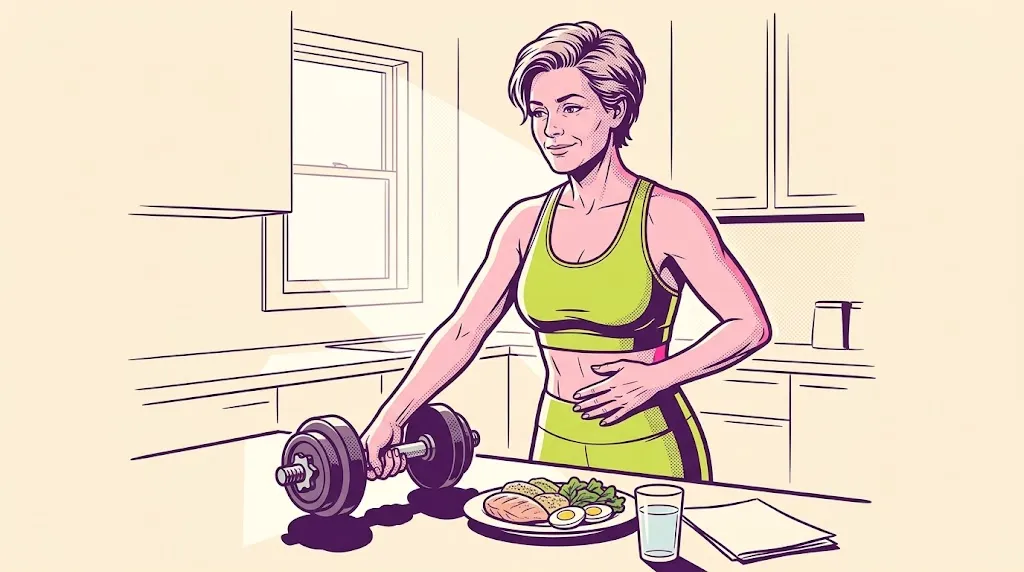
Lift something heavy, twice a week. The 2025 systematic review and meta-analysis in Frontiers in Physiology looked at resistance training in people with MASLD and found significant reductions in liver fat, liver enzymes and insulin resistance. The trials covering 395 participants showed liver fat falling on imaging. Here is the part worth reading twice: these benefits appeared even without a change in body composition on the scales. Your liver responds to the muscle contracting, not to the number under your feet. That is a completely different deal from the one the diet industry has been offering you.
Two sessions a week is the research floor, not a compromise. You do not need 6 days. You need 2, done properly, with enough load that the last few repetitions are hard.
Build the muscle, because the muscle is the storage. Skeletal muscle is where most of the glucose in your bloodstream goes. Less muscle means more glucose circulating, more insulin, and more fat routed to the liver. This is why the muscle loss that speeds up in perimenopause is not only a strength problem. It is a liver problem, a blood sugar problem and a long-term health problem wearing a strength problem's clothes.
Move after eating. Walking for 10 to 15 minutes after your main meal blunts the glucose rise before it reaches the liver as a package to deal with. It is small. It is not impressive. It works.
Get protein at each meal. Muscle cannot be built from an intention. Roughly 25 to 30g of protein per meal gives the muscle enough raw material to respond to the training you are doing.
Ask for the FIB-4. Not a vague request to check your liver. Ask by name. Say you are in perimenopause, you understand that oestrogen decline raises fatty liver risk, and you would like a FIB-4 score calculated from your existing bloods. It is a specific ask, and specific asks get taken more seriously than general worry. If it comes back raised, that is not bad news. That is 10 years of warning.
Keep alcohol honest. MASLD is not caused by alcohol, but alcohol does not help a liver that is already holding fat. You do not have to stop. You do have to be truthful with yourself about the actual number of units.
I am 55. I did not know any of this at 45. Nobody handed me a sheet explaining that the organ doing 500 separate jobs in my body was going to change its behaviour because of a hormone I associated only with periods and mood. If somebody had, I would have started lifting properly a decade earlier than I did.
Frequently Asked Questions
Can fatty liver in perimenopause be reversed?
In the early stage, yes. Liver fat is reversible. The liver is one of the few organs that genuinely repairs itself when the conditions change. What is much harder to reverse is fibrosis, the scarring that develops when fat sits there for years alongside inflammation. This is why the timing matters more than the panic. Finding it at 47 is a very different situation from finding it at 67.
My liver blood test was normal. Am I fine?
Not necessarily. A normal ALT does not exclude fatty liver, and this is one of the most common misunderstandings in the whole area. Standard liver function tests were designed to detect liver damage, not liver fat. Ask for a FIB-4 score, which uses your age, ALT, AST and platelet count and is the calculation NICE guideline NG49 points GPs towards. If concern remains after that, an ultrasound or a fibroscan is the next step.
I am slim. Surely this does not apply to me?
It might apply to you more than you think. The 2024 cohort found the menopause-related rise in fatty liver was pronounced in lean women and in women without abdominal obesity. Visceral fat, which sits around the organs and is invisible from the outside, was doing the mediating. Being slim tells you about the fat under your skin. It tells you very little about the fat around your liver.
Does HRT help my liver?
The picture is genuinely mixed and route seems to matter. A retrospective cohort from South Korea found oral hormone therapy was associated with fatty liver prevalence rising from 25.3% to 29.4% over a year, while transdermal therapy was associated with it falling from 24.0% to 17.3%. That is one study and it is observational, so it is not a prescription. It is a reason to have a proper conversation with your GP or a menopause specialist about route rather than assuming all HRT behaves the same way. The British Menopause Society is a sensible place to read further.
Is this something Body Reclaim covers?
Yes, though not as a liver programme. Body Reclaim is 12 weeks of building back the muscle you have been losing, with strength training that actually loads you, protein you can manage in a real week, and recovery that is not an afterthought. Those are the same 3 things the liver research keeps pointing at. You train for strength and the liver benefits are part of what comes with it. Join the waitlist to be notified when the next intake opens.
Normal is not the same as checked
Here is what I want you to take from this.
You have probably been told at some point that your bloods were normal, and you went home and stopped asking. That is what most of us do. It is reasonable. But normal is not the same as checked, and in perimenopause the difference between those two words is worth about 10 years.
Nothing in this is about fear. The evidence on the liver in midlife is actually some of the most hopeful evidence there is. Twice a week of proper strength training measurably lowers liver fat, and it does it whether or not the scales cooperate. You do not have to earn it with punishment. You have to do it consistently, for long enough that it adds up.
That is what I teach. Small repeated yes's that compound, in an order that makes sense, at 55 and at 45 and at 62.
Join the waitlist to be notified when the next Body Reclaim enrolment opens.
About the author. Jane Cox is a fitness teacher and coach based in the UK. She is 55, has spent years working with women in perimenopause and menopause, and is the founder of Body Reclaim, a 12 week strength and recovery programme for women over 40 who are done being told to eat less and move more.

Our Method
The Compound Method™ Mission Ethos
Programs & Shop
Programs Shop Join the Priority List →
Learn
Follow Us
© 2026 Everbodi™. All rights reserved. UK. Terms · Privacy Results may vary. Consult a qualified health professional.