Why Does Bloating Get Worse in Perimenopause (And What Has Your Gut Got to Do With It)?
Programs Testimonials Shop About Contact
Bloating gets worse in perimenopause because falling oestrogen changes 2 things at the same time. It slows down how quickly food moves through your gut, and it changes the mix of bacteria living in there. Food sits for longer. Different bacteria feed on it. More gas gets made, and it has further to travel before it leaves. That is the whole answer, and it has very little to do with how much you ate at lunch.
The part almost nobody explains is that this is now measurable. In January 2025, researchers presented data from 70,399 peri and postmenopausal women and, for the first time, linked specific gut bacteria to how severe a woman's menopause symptoms were. So when your waistband is tight by 4pm on a sandwich and a coffee, that is not you being greedy or careless. It is a real physical change, and there are sensible things you can do about it.
Key takeaways
Perimenopause bloating is mostly about slower gut movement and a changing mix of gut bacteria, not about how much you ate.
Gut bacteria diversity drops after menopause in most studies that have looked at it, and postmenopausal gut profiles start to resemble men's more than they resemble premenopausal women's.
Bloating is gas and fluid. Body fat is body fat. They behave completely differently and they need completely different responses.
UK women average around 17g of fibre a day against a recommendation of 30g, and only 9% of UK adults hit the target.
Gut work belongs after your energy, protein and strength are in place. Do it first and it rarely sticks.
The 4pm waistband, and why it is not your lunch
Here is the pattern I hear most often from women in their 40s and 50s.
Mornings are fine. You get dressed, everything sits where it should, you feel like yourself. By mid afternoon your trousers are digging in, your stomach looks 3 months pregnant, and you have eaten a bowl of porridge and a chicken sandwich. By 9pm you have changed into something with an elasticated waist and quietly written off the day.
Then the guessing starts. Was it the bread. Was it the milk in the coffee. Was it the onions. You start cutting things out. Gluten goes first, usually. Then dairy. Then, a few months later, half a dozen foods you used to enjoy have gone and the bloating is still there at 4pm.
I went through this in my own body. I am 55. There was a stretch in my late 40s where I was convinced something was seriously wrong, because the same lunch I had eaten for years suddenly made me look and feel completely different by the afternoon. Nothing about my food had changed. Something about my gut had.
Oestrogen does more than most women are ever told. It has receptors throughout the digestive tract. When oestrogen levels start swinging and then falling in perimenopause, gut motility slows. Motility is just the word for the muscular squeeze that moves food along. Slower squeeze means food spends longer in the system. Longer in the system means more time for bacteria to ferment it, and fermentation makes gas.
At the same time, bile flow tends to drop, which affects how well fat is broken down. Constipation becomes more common. And the population of bacteria in your gut starts to shift.
None of that is a discipline problem. It is a plumbing change that happened without anyone giving you notice.
What the research actually shows
The specifics matter here, because vague reassurance is not much use.
The gut bacteria change, and it is measurable
Researchers have been comparing the gut bacteria of pre and postmenopausal women for a few years now. When you pool those studies together, a consistent picture appears. Across 5 separate studies, gut bacteria diversity was lower after menopause, or in women with low oestrogen. In 3 out of 10 studies reviewed, postmenopausal women's gut profiles looked more like men's than like the profiles of premenopausal women.
Lower diversity matters because a varied population of bacteria is generally a more resilient one. Specific groups shift too. Levels of Firmicutes and Ruminococcus tend to fall, while Butyricimonas, Dorea, Prevotella, Sutterella and Bacteroides tend to rise.
The 70,399 women study
In January 2025, the ZOE research team presented findings at the Nutrition Society Winter Conference from 70,399 peri and postmenopausal women taking part in their PREDICT studies. It is the first research to link menopause symptoms directly to gut bacteria.
They scored each woman's diet quality, sequenced her gut bacteria, and asked her to complete a menopause questionnaire covering which symptoms she had and how much they affected her life.
They found 32 bacterial species linked to both menopause symptoms and diet quality. The single strongest predictor of both was a bacterium so newly identified it does not have a common name yet, listed as Lachnospiraceae SGB4964.
I want to be careful here, because this is the point where a lot of online content goes off the rails. This study shows a link. It does not prove that changing your gut bacteria will clear your symptoms. But it does mean that the food going in and the symptoms coming out are connected through your gut, which is worth knowing.
The oestrogen loop nobody mentions
There is a group of gut bacteria that produce an enzyme called beta glucuronidase. Researchers have given this group a name: the estrobolome.
What it does is simple enough. Your liver packages up used oestrogen ready to be excreted. Certain gut bacteria can unpackage some of it, which allows it to be reabsorbed and used again rather than leaving the body.
So the state of your gut has some influence over how much oestrogen stays in circulation. A 2025 review published in Post Reproductive Health went through the evidence on this, and on whether prebiotics and probiotics can shift it. The honest summary is that the link is real and the treatments are promising but not settled. Anyone selling you certainty on this is ahead of the science.
What happened when postmenopausal women trained for 12 weeks
This is my favourite finding, because it is the one that gets ignored.
In the PACWOMan trial, 17 postmenopausal women did 12 weeks of combined interval and resistance training. Their abdominal and visceral fat went down. Their fitness went up. So far, so expected.
But the training did not change the group's gut bacteria diversity in any meaningful way. What it did do was more interesting: each woman's gut bacteria at the start predicted how much her body composition changed over the 12 weeks.
In plain terms: the exercise changed their bodies. The gut did not change much, but it seemed to influence how well each woman responded.
That is a very different message from the one you get sold. Your gut appears to influence how well you respond to training. The training is still what changes the body.
The fibre gap
One more number, because it is the most actionable one here.
The UK government recommends 30g of fibre a day. According to the National Diet and Nutrition Survey, UK women average around 17g. Only about 9% of UK adults hit 30g.
Fibre is what most of your useful gut bacteria eat. Most women in this country are feeding theirs about half of what they need, and then wondering why their gut is unhappy in a decade when oestrogen is no longer doing them any favours.
So what do you actually do about it
I am going to give you this in order, because order is the bit that gets missed.
First, separate bloating from body fat
These are 2 different things and they need 2 different responses.
Bloating changes within a day. Flat in the morning, swollen by evening, back to normal after a good night's sleep or a decent walk. It is gas and fluid.
Body fat does not do that. It does not appear between breakfast and dinner and disappear overnight.
If your stomach is noticeably different at 8am and 8pm, you are looking at bloating. Judging your body composition on how you look at 4pm is a good way to feel terrible about a body that is doing nothing wrong.
Second, look at your energy before you look at your gut
I know this sounds like a detour. It is not.
If you are exhausted, you eat differently. You skip meals and then overeat at night. You reach for quick carbohydrates at 3pm. You skip the walk. You go to bed late. Every one of those things slows your gut down further and makes bloating worse.
Sorting your energy is unglamorous and it is where everything else becomes possible. There is no point layering gut protocols on top of a woman who is running on 4 hours of broken sleep and a coffee.
Third, add fibre slowly and add water with it
If you are on 17g and you jump to 30g in a week, you will feel worse. Noticeably worse. More gas, more discomfort, and you will decide fibre is the enemy.
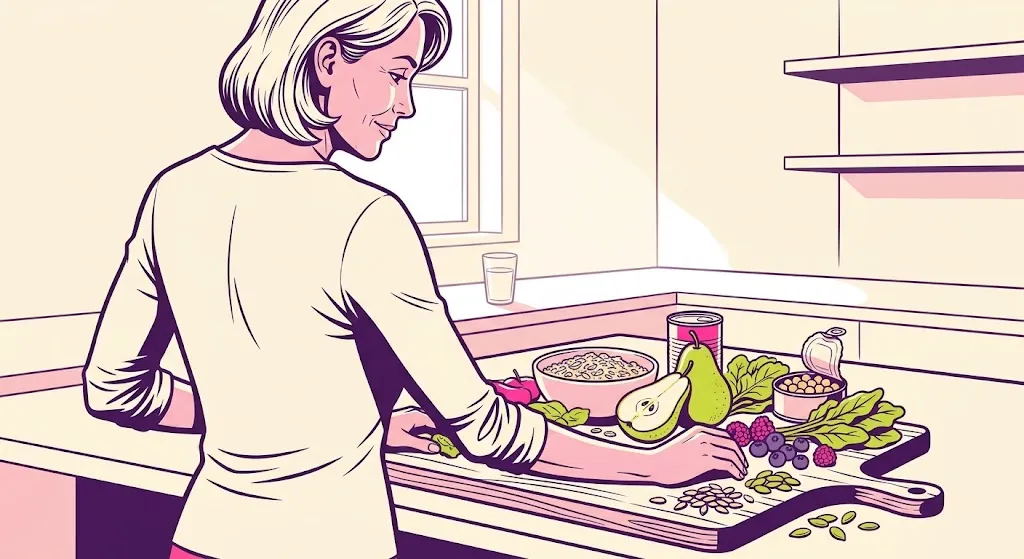
Add roughly 5g a week. That is a pear, or 2 tablespoons of oats, or half a tin of chickpeas. Drink more water alongside it, because fibre without fluid in a slow gut is a recipe for exactly the discomfort you are trying to avoid.
Aim for variety rather than volume. Different bacteria eat different fibres. Getting 30 different plant foods across a week does more for diversity than eating a mountain of the same 3.
Fourth, walk after you eat
Ten to 15 minutes of walking after your largest meal is one of the highest value, lowest effort things you can do for a slow gut. Movement speeds up gut transit. Gas that keeps moving does not build up.
This is not exercise. It does not need kit or a change of clothes. It is a walk round the block after dinner.
Fifth, strength train, but not for your gut
Strength training is the single most useful thing a woman over 40 can do for her muscle, her bones and her body composition. The gut evidence, as we saw with PACWOMan, is much weaker than the marketing suggests.
Train because it protects your muscle and your bone. Any gut benefit is a bonus, not the reason.
Sixth, and only then, think about specific gut work
Prebiotics, probiotics, fermented foods, meal timing. All of it has a place. All of it works better once your energy, your protein and your movement are already in place.
That is not me being precious about order for the sake of it. It is that the technical layers only stick when the foundations underneath them are steady.
Questions women ask me about this
Is perimenopause bloating the same as putting on body fat around my middle?
No. They can happen at the same time, which is what makes it confusing, but they are different. Bloating is gas and fluid, and it changes across a single day. Body fat changes over weeks and months. A useful test is to compare how you look first thing in the morning with how you look at 8pm. A big difference points to bloating. A steady, unchanging shape change points to body composition.
Should I cut out gluten or dairy?
Not as a first move. Cutting out food groups without a clear reason narrows your diet, reduces the variety of plants your gut bacteria get, and often makes things worse over time. If you have a genuine suspicion about a specific food, keep a simple diary for 2 weeks and take it to your GP or a registered dietitian rather than removing things on a hunch. I coach fitness and nutrition habits, not clinical diagnosis, and this is one to get proper eyes on.
Will a probiotic sort it out?
Possibly a little, and it depends enormously on the strain and the person. The 2025 review in Post Reproductive Health found the evidence for prebiotics and probiotics in menopause promising but not conclusive. My honest position is that a probiotic sitting on top of 17g of fibre a day is doing very little. Feed the bacteria you already have first.
How long does perimenopause bloating last?
There is no clean answer, and anyone who gives you one is guessing. For some women it settles as hormone levels stabilise after menopause. For others it persists, particularly if fibre, fluid, movement and sleep have not been addressed. If bloating is persistent, painful, comes with bleeding changes, or comes with unexplained changes in body weight, that is a conversation for your GP rather than a fitness coach. The British Menopause Society has good, non commercial information you can take with you.
Does Body Reclaim cover gut health?
Yes, and deliberately not in week 1. Gut health is one of the later weeks of the 12, once energy, perimenopause nutrition, strength and the food in your kitchen have already been worked on. Putting it earlier would mean adding a technical layer to a woman who is still exhausted, and it would not last. Join the waitlist to be notified when the next intake opens.
Where this leaves you
If you take one thing from all of this, make it this: your gut got slower, and that is worth knowing before you cut another food group out.
The bloating is not a sign that you have lost control of your eating. It is a predictable response to a hormone change, sitting on top of a fibre intake that was probably never quite enough, in a body that is moving less than it used to.
Start with your energy. Add fibre slowly. Walk after dinner. Get strong. Then, when all of that is normal rather than effortful, look at the specific gut work.
That is the whole thing, in the right order at the right time.
Join the waitlist to be notified when the next Body Reclaim enrolment opens.
About the author
Jane Cox is a personal trainer and menopause specialist based in Bournemouth, and the creator of Body Reclaim, a 12 week program for women over 40. She is 55, has spent years in the fitness industry, and went through her own perimenopause, body composition changes and life upheaval before building the approach she now teaches. She writes for women who have already tried everything and are tired of being told to try harder.

Our Method
The Compound Method™ Mission Ethos
Programs & Shop
Programs Shop Join the Priority List →
Learn
Follow Us
© 2026 Everbodi™. All rights reserved. UK. Terms · Privacy Results may vary. Consult a qualified health professional.