Why Are My Breasts So Sore in Perimenopause (And Why Is It Almost Never What You Fear)?
Programs Testimonials Shop About Contact
Your breasts hurt in perimenopause because oestrogen is not falling in a neat downward line. It is swinging. Up, down, up again, sometimes higher than it ever was in your 30s. Those swings make breast tissue hold fluid and swell, and the ducts and lobules inside get more sensitive with it. The pain can be sharp, heavy, burning, or a dull ache on one side that will not leave you alone. It is one of the most common symptoms of the whole perimenopause and one of the least discussed.
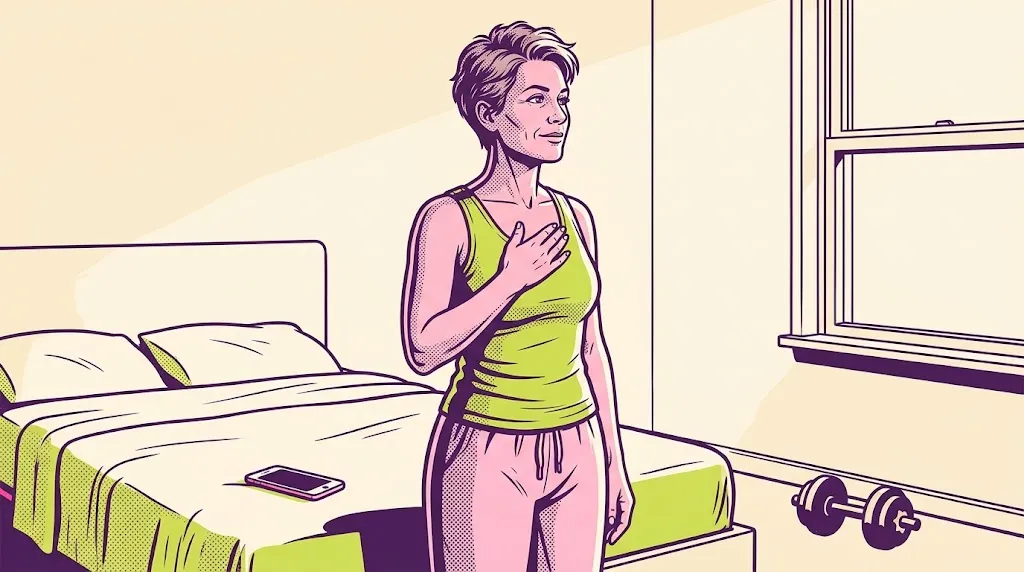
Here is the part nobody says fast enough. Breast pain on its own is almost never cancer. In a prospective study of 10,830 women referred to a breast diagnostic clinic, the cancer rate among women whose only symptom was pain was 0.4%, against roughly 5% in each of the groups who arrived with a lump, a nipple change, or another symptom. The authors concluded there was no association between breast pain and breast cancer at all. If you have been lying awake at 2am with your hand on your chest, waiting for a scan date, read that number again.
Key Takeaways
Breast pain affects up to 70% of women at some point, and the kind that has nothing to do with your cycle becomes more common after 40
In 10,830 women referred with symptoms, breast cancer turned up in 0.4% of those whose only symptom was pain, and researchers found no link between the two
Almost 1 in 5 referrals to UK breast clinics are for breast pain, a symptom that does not predict cancer
It usually settles on its own. Breast discomfort was 21% lower in late perimenopause than in early perimenopause
After menopause your fat tissue becomes the main place oestrogen is made, which is why body composition is one of the few risk factors genuinely in your hands
The symptom that arrives without a warning
For most of your life, sore breasts meant something predictable. A few days before your period, tender and swollen, then gone. You knew the pattern so well you barely thought about it.
Perimenopause breaks the pattern. The pain stops arriving on schedule. It turns up in the middle of the month, or stays for 3 weeks, or lands on one side only and feels like a burning line rather than a general ache. Bras stop being comfortable. Sleeping on your front becomes impossible. Some women describe it as feeling bruised from the inside.
Doctors have a word for the kind that follows your cycle (cyclical) and the kind that does not (non-cyclical). The second kind is far more common in women over 40, which is exactly why it frightens people. The rules you learned at 25 no longer apply, and nobody has given you new ones.
So you do what any sensible person does. You go online at 11pm and you type your symptom into a search box, and within 4 clicks you are reading about inflammatory breast cancer. You book the GP appointment. You wait. You spend 2 weeks in a state most people never talk about out loud.
I am 55. I have sat with hundreds of women in their 40s and 50s in gyms and on calls, and this one comes up more than almost anything else, usually sideways, usually after we have been talking about something else for 20 minutes. It comes with a specific kind of fear, because breasts are not like knees. Nobody thinks a sore knee is going to kill them.
What the research actually found
The single most useful study on this came out of a breast diagnostic clinic and followed 10,830 women who had been referred with symptoms. The researchers split them into 4 groups by what brought them in: breast pain, a lump, a nipple change, or other symptoms.
In the breast pain group, 0.4% were found to have cancer. In each of the other 3 groups, it was around 5%. That is more than 10 times the rate. The conclusion was blunt: there is no association between breast pain and breast cancer.
A newer retrospective cohort, published in 2026 in BMC Primary Care, followed women presenting to primary care with breast symptoms and looked specifically at isolated breast pain. Across 588 episodes of isolated mastalgia, there were no cases of breast cancer at all.
Older hospital data lines up. One review of breast clinic referrals put cancer incidence in patients presenting with pain alone at 0.8%, and noted that almost 1 in 5 referrals to breast clinics are women with pain, a symptom that does not predict the disease. That is a lot of frightened women in a lot of waiting rooms, for a symptom the evidence keeps clearing.
None of that means ignore your breasts. A lump, a change in skin texture, a nipple that turns inward or leaks, a patch that looks like orange peel, any of those get checked, properly and quickly. Pain on its own sits in a different category, and the research is unusually consistent about it.
There is one more finding worth having. Researchers tracking women through the stages of the menopause transition found that breast discomfort was 21% lower in late perimenopause than in early perimenopause. Which tells you something the internet rarely does: for most women, this settles. It is loudest in the early years when the hormone swings are wildest, and it quietens as the swings flatten out.
The conversation nobody has with you
Here is what I find hard about all of this.
A woman spends 3 weeks terrified, gets her scan, gets the all clear, cries in the car park, and goes home. And at no point in that entire process does anybody sit her down and tell her about the risk factors she can actually do something about.
So let me do that part.
After menopause, your ovaries stop being the main source of oestrogen. Your fat tissue takes over. An enzyme called aromatase, which sits in fat cells, converts other hormones into oestrogen, and the more fat tissue you carry, the more oestrogen your body makes. Breast tissue is particularly sensitive to oestrogen made this way. Research published in the Journal of Clinical Endocrinology and Metabolism found that menopause status itself changes how much aromatase is expressed in breast tissue, and that expression is tied to body composition and inflammation.
This is not about how you look. It is about where your oestrogen comes from once your ovaries stop supplying it.
An analysis from the Women's Health Initiative found that modifiable risk factors account for roughly 23% of breast cancers, with body composition and alcohol the 2 largest. Cancer Research UK states plainly that carrying excess body fat after menopause raises risk, and that there is no safe level of alcohol.
On the movement side, a meta-analysis of 38 cohort studies found a relative risk of 0.91 for physically active postmenopausal women, so around 9% lower. Another pooled analysis of 31 prospective studies put the overall reduction at 12%. These are not miracle numbers. They are real ones, and they compound with everything else strength training does for your bones, your muscle, your blood sugar and your sleep.
Now stack that against what the fitness industry sells women over 40. Ninety-day shred. Eat less, move more. Burn it off. All of which tends to strip muscle alongside fat, leaves you with less lean tissue than you started with, and quietly makes the fat-to-muscle ratio worse. You end up carrying more of the tissue that makes oestrogen and less of the tissue that protects your bones and your blood sugar.
What actually helps, in order
First, get it checked once and then stop checking it hourly. See your GP. Describe it properly: which side, how long, whether it moves with your cycle, whether anything else has changed. If there is no lump and no skin or nipple change, the odds are overwhelmingly in your favour, and knowing that from a person rather than a search engine matters. The British Menopause Society has plain-English factsheets you can take in with you.
Then, deal with the pain itself. A properly fitted bra makes a bigger difference than most women expect, including one worn at night in bad weeks. Many women find that cutting caffeine helps, though the trial evidence on that is thin. Heat, over the counter anti-inflammatory gel, and simply knowing it is coming all take the edge off. If it is severe and persistent, that is a conversation with your GP about options, including whether any medication you are already on is contributing.
Then, build the thing that changes your next 20 years. Lift heavy enough to be hard. Two or 3 sessions a week, full body, with the load going up over time. Eat enough protein to hold onto the muscle you build. Look honestly at alcohol, because it is the risk factor most women in their 50s underestimate by the widest margin.
That last block is the whole of it, and none of it happens in 90 days. It happens in small daily yes's that stack for 12 weeks and then keep going. That is what the Compound Method is built around, and it is why Body Reclaim runs over 12 weeks and not over a weekend.
Frequently asked questions
Is breast pain in perimenopause a sign of cancer?
Almost never on its own. In a study of 10,830 women referred with breast symptoms, 0.4% of those whose only symptom was pain had cancer, against about 5% in the lump and nipple change groups, and the researchers found no association between pain and cancer. A 2026 primary care cohort found no cancers at all across 588 episodes of isolated breast pain. A lump, nipple discharge or change, skin dimpling or puckering are different and should be checked straight away.
Why has my breast pain stopped following my cycle?
Because your cycle itself has stopped being regular. Oestrogen in perimenopause swings rather than declining smoothly, so the fluid retention and tissue sensitivity that used to arrive 5 days before a period can now turn up any time. Pain that does not track your cycle is called non-cyclical and is more common in women over 40 than in younger women.
Does HRT make breast pain worse?
It can, particularly in the first few months while your body adjusts to the dose. Research on women starting menopausal hormone therapy found breast discomfort was one of the more common early complaints. It often settles, and a dose or delivery change frequently helps. That is a conversation with the prescriber rather than a reason to stop on your own.
Will this ever go away?
For most women, yes. Researchers tracking women through the menopause stages found breast discomfort was 21% lower in late perimenopause than in early perimenopause. The worst of it tends to sit in the early years when hormone levels are at their most unpredictable, and it eases as those levels stabilise.
I want to train properly for this but I do not know where to start. What do I do?
Start with 2 full body strength sessions a week and enough protein to support them, and add load over time rather than adding more sessions. If you want structure and someone checking your form and your order of operations, that is what Body Reclaim is for. It runs over 12 weeks, it is built for women in their 40s and 50s, and it is about body composition rather than what the scales say. Join the waitlist to be notified when the next intake opens.
Sore breasts in perimenopause are miserable, they are frightening in a way most symptoms are not, and the evidence says they are very rarely what you are afraid of. Get it looked at once so you can put it down. Then spend the attention you were spending on fear on the things that genuinely change what happens next: the muscle you build, the protein you eat, the alcohol you do not drink.
Your mum probably never got told any of this. You just did.
Join the waitlist to be notified when the next Body Reclaim enrolment opens.
About the author
Jane Cox is 55 and has spent years coaching women through perimenopause and menopause. She is the founder of Body Reclaim and the creator of the Compound Method, a 12 week approach built on small daily decisions rather than short bursts of punishment. She writes for women in their 40s and 50s who have been told to eat less and move more for long enough.

Our Method
The Compound Method™ Mission Ethos
Programs & Shop
Programs Shop Join the Priority List →
Learn
Follow Us
© 2026 Everbodi™. All rights reserved. UK. Terms · Privacy Results may vary. Consult a qualified health professional.