Does Muscle Soreness Mean Your Workout Worked? (What the 2024 to 2026 Research Actually Says)
ProgramsTestimonialsShopAboutContact
No. Muscle soreness tells you that your muscles did something new or unfamiliar. It does not tell you they got stronger, and it does not tell you the session was a good one. The ache that shows up 1 to 3 days after training has a proper name, delayed onset muscle soreness (DOMS), and the research is clear that muscle can grow and strength can climb with very little soreness at all.
Here is the part that surprises most women I coach. The better your training is going, the less sore you should expect to feel. A study published in the Journal of Applied Physiology in February 2026 showed that when people repeated the same hard session 3 weeks later, their nervous system had already adapted to protect the muscle. Less soreness was a sign of progress. It was not a sign the work had stopped paying off.
Key Takeaways
Soreness is a sign of new or unfamiliar work. It is not a measure of results.
DOMS usually peaks 24 to 72 hours after training and clears within 5 to 7 days.
After just 1 tough session, your body protects itself for next time. This is called the repeated bout effect, and it is a good thing.
A 2024 review of 16 studies found foam rolling helps soreness most when you use it 24 hours or more after training.
Judge your training by what you can lift, carry and do. Not by how hard it is to get off the sofa.
Why so many women chase the ache
I'm 55 and I have coached women for years. One message turns up in my inbox more than any other after a first week of strength training. It goes something like this: "I can't sit on the loo without holding the sink. That means it's working, right?"
I understand why. Most of us grew up on "no pain, no gain." We did the step classes, the bootcamps, the 6am sessions where the instructor shouted "feel the burn." If you walked out of a class and felt fine the next day, you assumed you hadn't tried hard enough.
So here is what happens next. The soreness wears off after a few weeks, because your body has adapted. And instead of seeing that as a win, you decide the programme has stopped working. So you change it. New exercises, more sets, a different class. The soreness comes back, and you feel reassured.
But you have just thrown away the thing that actually builds muscle, which is doing the same movements for long enough to get stronger at them. Chasing the ache keeps you starting over. Month after month, you are a beginner again, sore again, and no stronger than you were in spring.
There is a second trap too. Some women get so sore in week 1 that they cannot face a second session. They skip 4 or 5 days, lose the habit, and quietly decide strength training "isn't for them." It was never the training that was wrong. It was the dose.
What DOMS actually is
DOMS is the dull, tender ache that builds a day or 2 after unfamiliar exercise. It usually peaks somewhere between 24 and 72 hours, and according to the authors of a 2025 trial in Frontiers in Physiology, symptoms typically clear within 5 to 7 days.
It comes mostly from the lowering part of a movement. Scientists call this the eccentric phase. Think of the slow lowering in a squat, the walk down a steep hill, or letting a dumbbell come back down in a biceps curl. Your muscles are working while they lengthen, and that creates small areas of disruption in the muscle fibres. Your body responds with a local repair process, and the nerves in the area become more sensitive for a few days. That sensitivity is what you feel when you press on your thigh and wince.
While you are properly sore, your muscles really are weaker. The same 2025 paper notes that eccentric strength can drop by as much as 43.5% during DOMS. That is one reason a very sore week is not the time to chase a personal best.
Now look at what causes the most soreness. Downhill running is famous for it. A long hill walk on holiday can leave your calves and thighs aching for days. Neither of those builds much muscle. If soreness were the signal for growth, a day out walking in the Lake District would beat a 12 week strength programme. It doesn't.
What the research says about soreness and results
Muscle can grow without much soreness
An often cited 2011 study by Flann and colleagues, summarised well by Stronger by Science, split people into 2 groups. One group was eased in gently so they avoided heavy soreness. The other went straight into hard training and got very sore. After the training block, both groups gained similar muscle size and strength. The extra soreness bought them nothing, apart from a few uncomfortable days.
The main drivers of muscle growth are tension on the muscle (lifting something challenging) and enough total work over time. Soreness can come along for the ride, but it is a passenger, not the driver.
Your body learns fast: the repeated bout effect
Here is where the newest research gets interesting. In the February 2026 Journal of Applied Physiology study, 23 adults did 10 sets of 10 hard lowering reps for the muscles at the front of the shin. They came back 3 weeks later and repeated exactly the same session.
After the first session, strength dropped and soreness rose, just as you would expect. After the second, the damage symptoms were smaller. The researchers used detailed muscle recordings to see why, and found that the nervous system had changed how it switched the muscle on. The signals were steadier and more even, which spread the load across the muscle more safely.
In plain English: after 1 tough session, your brain and muscles work out how to share the job better. That is the repeated bout effect. It is also why the second week of a new programme almost always feels easier than the first.
This isn't just true for young men in a lab. A June 2024 study in the journal Sports looked at 10 trained female distance runners doing downhill running, 2 sessions 3 weeks apart. The second time round, they reported less soreness. Same women, same hill, same effort. Their bodies had simply learned.
So when the soreness fades, your training has not stopped working. It is working exactly as it should.
What actually helps when you are sore
There is a lot of money spent on recovery gadgets. Here is what the recent evidence says, kept simple.
Most recovery methods help a little. Doing nothing helps least.
The 2025 Frontiers in Physiology trial compared 5 different recovery methods against doing nothing. Participants did a session designed to make their thigh muscles very sore. They then had either 10 minutes of massage, 12 minutes in cold water, vibration therapy, gentle static stretching, or electrical muscle stimulation. A sixth group had no treatment at all.
By 48 hours, every one of the 5 treatment groups had recovered more of their leg power than the group who did nothing. Massage was the standout for easing stiffness and lowering the blood markers of muscle damage. Stretching helped most with range of movement.
One honest caveat. It was a small study of 30 young male students, 5 per group. So treat it as a useful pointer, not the final word. The message that holds up is this: some gentle recovery work is better than lying on the sofa waiting for it to pass.
Foam rolling works best a day later
A 2024 systematic review and meta-analysis pulled together 16 studies with 515 people. It found foam rolling did reduce muscle soreness. But the timing mattered. Rolling straight after a session made only a tiny difference. The effect became much clearer when it was used 24 hours or more afterwards.
So if your legs are tender the morning after squats, that is the moment to get the foam roller out. 5 to 10 minutes, slow and steady, no gritting your teeth through it.
The simple things still matter most
Keep moving. A 20 to 30 minute walk gets blood flowing through sore muscles and usually makes them feel better, not worse.
Do a lighter version of the same session. Using about half your usual load for the same movements is a proven way to ease stiffness and it keeps the habit going.
Sleep. Most repair happens overnight. A run of short nights will make soreness hang around longer.
Eat enough protein across the day. Your muscles need the raw materials to repair. Spread it over 3 or 4 meals rather than one big dinner.
Drink enough water. Sore, stiff muscles feel worse when you are dehydrated.
How to tell your training is working (without the ache)
If soreness is not the scoreboard, what is? These are the signs I look for with every woman in Body Reclaim.
The numbers go up. You lift a little more, or do 1 or 2 more reps at the same load, compared with 2 or 3 weeks ago. Write it down. A small notebook is enough.
The effort feels right. Most sets finish with about 1 to 3 good reps left in the tank. I explain how to judge this in How Hard Should Strength Training Actually Feel?
Daily life gets easier. The stairs, the shopping bags, getting up off the floor after playing with the grandchildren.
Your body composition shifts. Clothes fit differently. You look firmer, even when the scales barely move.
You recover faster. A session that flattened you in week 1 barely registers by week 4. That is the repeated bout effect showing up in your own life.
How to start without being wrecked for a week
If you are new, or coming back after a break, this is how I ease women in:
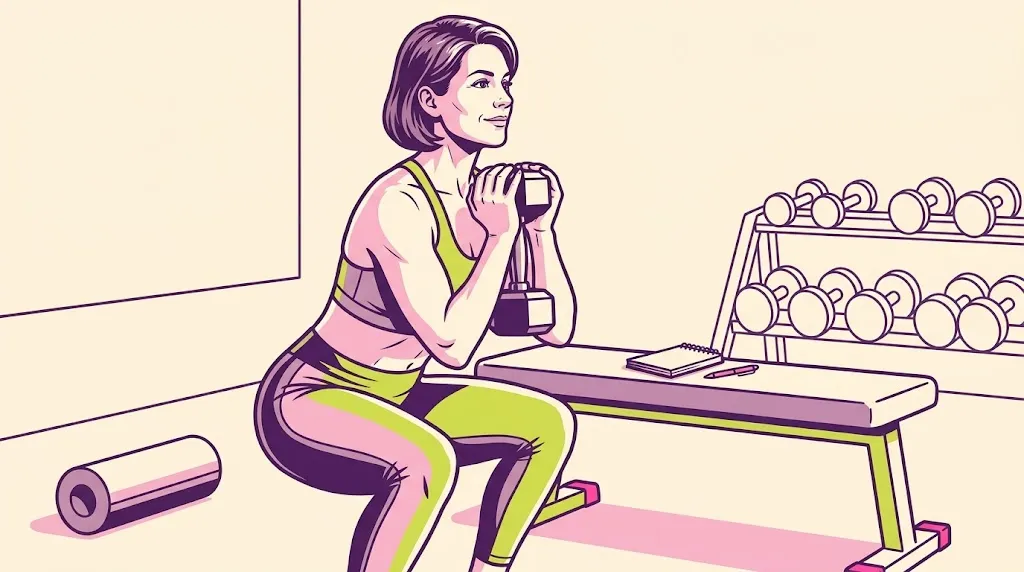
Week 1: 2 sets per exercise, not 3 or 4. Choose a load you could lift 4 or 5 more times.
Go gently on the lowering. Control it, but don't add extra-slow lowering in your first fortnight. That is where most soreness comes from.
Keep the same exercises for at least 4 to 6 weeks. This is what lets you get stronger rather than just sore.
Expect some soreness in week 1, less in week 2, and very little by week 3. That pattern means it is going well.
Train again even if you are a bit sore. Mild soreness is not a reason to skip. A lighter session often clears it faster than rest.
When soreness is a warning, not a normal ache
Normal DOMS is a dull, even ache in the muscle that eases as you warm up. Stop and get it checked if you notice any of these:
Sharp or stabbing pain, or pain in a joint rather than the muscle
Pain that gets worse as you move, instead of easing
Swelling, bruising or a limb that feels hot
Soreness that is still bad after 7 days
Very dark, cola-coloured urine after a hard session, alongside severe muscle pain and weakness. This needs urgent medical attention the same day.
If you are ever unsure, speak to your GP or a physiotherapist before your next session.
Frequently Asked Questions
Should I train if I'm still sore from my last session?
Usually, yes. Mild soreness is not a reason to skip. A lighter session, or training a different area of the body, often eases stiffness faster than resting. If you are so sore that you cannot move through a full range without pain, give that area another day and go for a walk instead.
Why am I more sore 2 days after training than the day after?
That is normal. DOMS builds as the local repair process gets going, and it usually peaks between 24 and 72 hours after the session. Day 2 is often the worst. By day 4 or 5 most people feel much better, and it typically clears within 5 to 7 days.
I don't get sore any more. Does that mean I've stopped making progress?
No. This is the repeated bout effect at work. A 2026 study in the Journal of Applied Physiology showed that after a single hard session, the nervous system adapts so the next one causes less damage and less soreness. Check your progress by what you can lift and do. If those numbers are still creeping up, you are progressing.
Why do I get really sore again after a holiday or a few weeks off?
The protection from the repeated bout effect fades if you stop training for a while, and some of your strength drops too. Come back at about 2 thirds of your old loads for the first week or 2 and build back up. You will get there faster than you did the first time.
How does Body Reclaim handle soreness for beginners?
In Body Reclaim, you start with fewer sets and loads that leave reps in the tank, and you keep the same core movements long enough to get properly stronger. Soreness is expected in week 1 and should fade from there. You track your lifts, not your aches, so you can see progress every week. Join the waitlist to be notified when the next intake opens.
Stop measuring your training by the ache
For years we were taught that a good workout should hurt the next day. The research from 2024 to 2026 says something kinder and more useful. Soreness is your body meeting something new. It fades because you adapt. And the women who get strongest are the ones who stick with the same simple plan long enough to see the numbers climb.
So next time you wake up and can walk down the stairs without wincing, don't panic. Pick up the same weights, see if you can do 1 more rep, and write it down. That is what progress looks like.
Join the waitlist to be notified when the next Body Reclaim enrolment opens.
About the author
Jane Cox is a 55-year-old strength and fitness coach and the founder of Body Reclaim, a 12 week strength programme for women built on The Compound Method™. She has spent years helping women build real strength with simple, consistent training that fits around busy lives, and she still lifts 4 times a week herself.

Our Method
The Compound Method™MissionEthos
Programs & Shop
ProgramsShopJoin the Priority List →
Learn
Follow Us
© 2026 Everbodi™. All rights reserved. UK.Terms·PrivacyResults may vary. Consult a qualified health professional.