Do You Need to Lift Heavy to Get Stronger? (What the Research Actually Says About Light vs Heavy Weights)
ProgramsTestimonialsShopAboutContact
Do You Need to Lift Heavy to Get Stronger? (What the Research Actually Says About Light vs Heavy Weights)
No, you do not need to lift heavy to build muscle. A network meta-analysis of 28 studies and 747 adults found that light, moderate and heavy loads grew muscle by about the same amount, as long as each set was taken close to the limit. But if you want to get stronger, heavier loads do win. So the best plan for most women over 40 is to use both.
I'm Jane, I'm 55, and I have spent years watching women sort themselves into two camps. One camp says "I'm not a heavy lifter" and sticks to the small dumbbells for ever. The other says "light weights are a waste of time" and then gets sore knees and quits in week 3. The research says both camps are missing half the picture. Here is what it shows, and how to put it into a week of training.
Key Takeaways
Muscle growth is similar across a wide range of loads (roughly 6 to 35 reps) when each set ends close to your limit.
Strength gains are bigger with heavy and moderate loads than with light ones, even when the light sets are hard.
A light set that stops with 10 reps left in the tank is a warm-up, not training. Effort matters more than the number on the dumbbell.
A 2026 trial in adults with an average age of 64.7 found both lighter and heavier loads improved leg strength in 8 weeks.
Mix it: some sets of 5 to 8 reps, most sets of 8 to 12, and a few lighter sets of 15 to 25.
Where the "lift heavy or go home" idea came from
For decades, the advice in gyms was simple. Heavy weights for strength, medium weights for size, light weights for "endurance". Charts on gym walls showed it as a tidy ladder, with 1 to 5 reps in one box, 8 to 12 in the next and 15 or more in the last.
That ladder was built on a mix of old lab work and what bodybuilders happened to do. A survey of 127 competitive bodybuilders found most of them trained in the 7 to 12 rep range. That tells us what they did. It does not tell us that nothing else works.
When researchers started putting the ladder to a proper test, most of it held up for strength and fell apart for muscle size. That is good news if you have a bad shoulder, a cranky knee, or a home gym with a pair of 5 kg dumbbells and nothing else.
What the research says about building muscle
The cleanest summary is the 2021 network meta-analysis in Medicine and Science in Sports and Exercise. It pooled 28 studies with 747 healthy adults. Across 35 comparisons from 24 studies, light, moderate and heavy loads produced similar muscle growth when the sets were taken close to the limit. Heavy loads had a tiny edge that the authors judged unlikely to matter.
An earlier trial, covered in this BarBend summary, tested 4 different loads: 20%, 40%, 60% and 80% of the heaviest weight a person could lift once. Each group trained until they could not do another rep. That meant averages of about 64, 30, 17 and 12 reps per set. The 40% to 80% groups gained similar muscle. The 20% group still grew muscle, just by less.
Read that again, because it surprises people. You can grow muscle with a weight you could lift 30 times. The catch is the last part of the sentence: you have to get close to your limit. We will come back to that.
One honest caution. In that 2021 analysis, the average age was 23.4 and 19 of the 28 studies included men. Women in their 40s and 50s are underrepresented in this research, which is a gap I see across most of the evidence. The patterns are consistent enough to act on, but it is worth knowing who was in the room.
What it says about getting stronger
Strength is where the picture changes. In the same 2021 analysis, across 39 comparisons from 24 studies, heavy and moderate loads increased the one-rep max more than light loads did, even when the light sets were taken close to the limit. The gap between heavy and moderate was not statistically significant.
A 2024 meta-analysis in the journal Life points the same way. It compared heavy lifting with light lifting using blood flow restriction cuffs, which is a technique where a cuff partly limits blood flow while you use light weights. Muscle gains were the same in both (standardised mean difference of 0.01). Strength gains favoured heavy lifting (standardised mean difference of -0.33).
A second 2024 review in Sports Medicine - Open found that people who were new to training gained similar muscle from light or heavy loads, but more strength from heavy ones.
Why would heavier loads build more strength if the muscle ends up the same size? Most coaches explain it as skill. Strength is not only about how big the muscle is. It is also about how well your nervous system recruits that muscle. Lifting a heavier weight practises exactly that, the same way practising a song at full speed makes you better at playing it at full speed.
If your goal is to carry a suitcase up the stairs, get up off the floor without a hand on the sofa, or hold your own on a hill walk, you want that skill. That is why I never let women skip heavier work entirely.
What a 2026 trial in adults aged 60 and over found
Most load research is done on young people, so I went looking for something closer to my clients. A 2026 randomised trial from the University of Basel, published in Current Issues in Sport Science, compared two loads in 16 older adults (10 women and 6 men) with an average age of 64.7.
One group trained at 40% of their one-rep max and the other at 60%, with every set taken close to the limit. They trained twice a week for 8 weeks. Both groups got stronger. Leg curl and leg extension gains were a little bigger in the lighter group (about 9.4% and 10.0% on average). Leg press gains were bigger in the heavier group. The researchers were clear that the confidence intervals crossed zero for several of these differences.
That is a very small trial, so treat it as a hint and not a rule. But it fits the bigger picture. Both loads worked. Neither group needed to lift anything close to a maximum to get stronger in 8 weeks, training just twice a week.
The catch with light weights
Here is where light training goes wrong. Every study above that found equal muscle growth from light loads had people train until they could not do another good rep. That is hard work.
Picture a light set. You pick up a weight you could lift 40 times. You do 15 reps, feel fine, and put it down. That set has not given your muscle a reason to change. A set of 30 with the same weight, where the last 8 reps are slow, shaky and burning, is a different thing altogether.
So if you are going to train light, there are 3 things to expect:
Sets of 20 to 30 reps take longer and feel uncomfortable in the muscle. The burn is real.
Your breathing and grip can give out before the target muscle does, especially on rows and deadlifts.
You need to stop with 1 to 3 reps left, and be honest about how many you really had left.
Heavier sets are shorter and often feel more manageable in the head. A set of 6 is over in 20 seconds. For many women I train, that is easier to commit to than a long burning set.
How I mix heavy and light training at 55
Here is the pattern I use for myself and for the women I coach. It is not complicated, and you can start it with the equipment you have now.
Step 1: Pick 1 or 2 big lifts and go heavier. Squats, deadlift variations, presses and rows. Use a weight where 5 to 8 reps is hard and you finish with 2 reps left. Rest 2 to 3 minutes between sets. Do 3 to 4 sets.
Step 2: Do your main work in the middle. Lunges, step-ups, dumbbell presses, lat pulldowns. Aim for 8 to 12 reps, finishing with 1 to 3 reps left. Do 2 to 3 sets each. This is where most of your training will sit.
Step 3: Finish with 1 or 2 lighter sets. Use lateral raises, leg curls, triceps work or calf raises. Pick a weight you can lift 15 to 25 times and go until the last few reps slow right down. These are easier on joints and fit well at the end of a session.
A simple week could look like this:
Day 1: Heavier lower body (squat or leg press for 5 to 8 reps), then moderate upper body push and pull (8 to 12 reps).
Day 2: Moderate full body (8 to 12 reps), finishing with lighter work (15 to 25 reps).
Day 3: Heavier upper body (press and row for 5 to 8 reps), then moderate lower body (8 to 12 reps).
If you only have 2 days, keep the heavier lift at the start of each session and put the lighter work at the end. Remember the Basel trial: twice a week for 8 weeks was enough to improve strength in people with an average age of 64.7.
What "heavy" actually means
"Heavy" does not mean the heaviest weight you could ever lift. It means heavy for you, today, for the number of reps you planned. If you are aiming for 6 reps and the sixth rep is slow but clean, with perhaps 2 more in the tank, that is a heavy set.
You do not need to test a one-rep max to train this way. In fact I would not bother. Pick a weight, do your reps, and see how it felt. If you finished with 5 reps left, add a little. If your form fell apart on rep 4, take a little off. Over 4 to 6 weeks you will find your numbers.
Add weight in small steps. A 1 to 2 kg jump on a dumbbell or a 2.5 kg jump on a barbell is plenty. Make the move only when you hit the top of your rep range on every set with good form.
Is heavier lifting safe if your joints are achy?
For most healthy women, yes, if you build up gradually. Joints usually cope better with heavier loads than people fear. What causes problems is jumping straight to weights your body has not adapted to, or rushing reps with poor technique.
Warm up with 2 lighter sets of the same lift before going heavier. Use a full, controlled range of movement. Take your time on the way down. If a movement causes sharp pain (as opposed to muscle effort), stop that exercise and swap it for a variation that feels better. Lighter loads are a perfectly good option on days when a joint is complaining.
If you have a medical condition, an injury or you are unsure, check with your GP or a qualified physiotherapist before changing your training. This article is information, not medical advice.
Frequently asked questions
Do I need to lift heavy to build muscle?
No. The 2021 meta-analysis of 28 studies found light, moderate and heavy loads grew muscle by a similar amount when sets were taken close to the limit. Heavy loads are better for building strength, so a mix is the most sensible approach.
How many reps should I do with light weights?
Plan for 15 to 30 reps, and choose a weight that makes the last 3 to 5 reps slow and hard. If you finish a set of 20 and could have done another 10, the weight is too light to count as training. Pick a heavier dumbbell or slow the lowering phase to 3 seconds.
How heavy is heavy for a beginner?
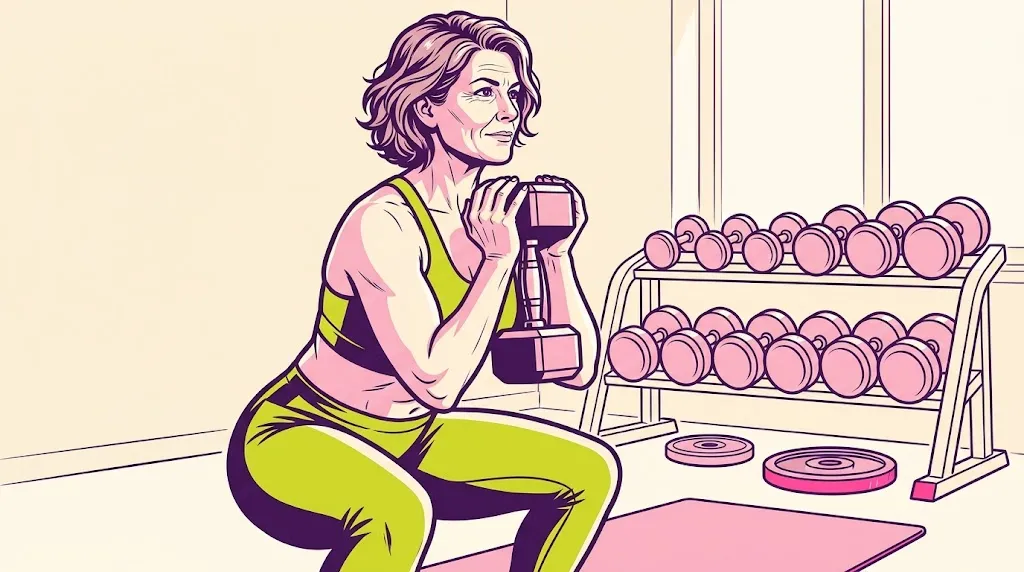
A weight you can lift for 5 to 8 clean reps while still having about 2 reps left. For a first-time squatter that might be a single 10 kg dumbbell held at the chest. For a regular lifter it may be a barbell. Heavy is relative to you, and it changes as you get stronger.
Can I get stronger just training twice a week?
Yes. In the 2026 Basel trial, adults with an average age of 64.7 trained twice a week for 8 weeks and improved leg strength with both lighter and heavier loads. The sample was small, but the result matches what coaches see in practice. Keep each session focused on the big lifts and progress slowly.
What is Body Reclaim and how does it use heavy and light training?
Body Reclaim is my 12 week strength programme for women over 40, built on the Compound Method™. Each week mixes heavier lifts, moderate main work and lighter finishers, so you get stronger and keep your joints happy at the same time. Join the waitlist to be notified when the next intake opens.
The short version
You do not have to pick a side. Lighter weights can build muscle if you work hard enough, and heavier weights will build more strength. If your joints feel good, lift some heavier. If they do not, lift lighter and take each set closer to the limit. Either way, the weight on the bar matters less than how honest you are about the last few reps.
Start this week with one heavier lift at the beginning of your session and one lighter finisher at the end. Write down what you lifted and how many reps you had left. That small record will show you progress long before the mirror does.
Join the waitlist to be notified when the next Body Reclaim enrolment opens.
About the author: Jane Cox is a fitness teacher and the founder of Body Reclaim. At 55, she coaches women over 40 to build strength, shape and confidence through the Compound Method™, 12 weeks of small daily yeses.

Our Method
The Compound Method™MissionEthos
Programs & Shop
ProgramsShopJoin the Priority List →
Learn
Follow Us
© 2026 Everbodi™. All rights reserved. UK.Terms·PrivacyResults may vary. Consult a qualified health professional.