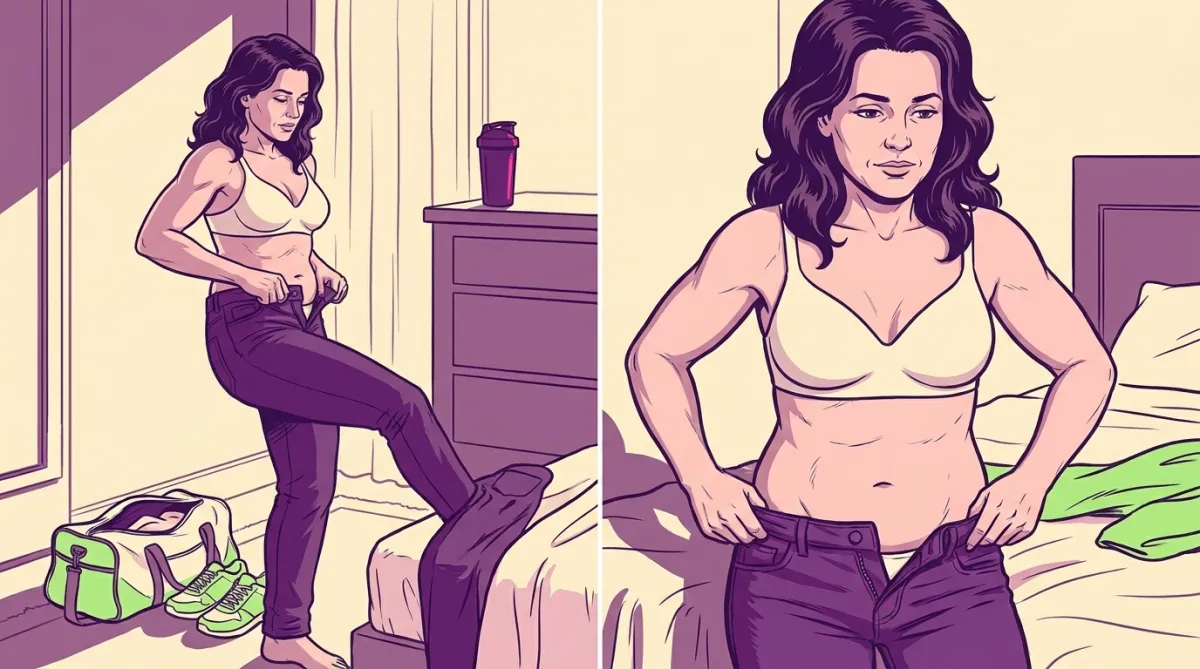
Why Are You Getting Softer in Your 40s, Even Though You're Exercising?
By Jane Cox | Body Reclaim | 1 July 2026
Yes, you are losing muscle. Not because you're doing something wrong. Not because you've stopped trying. And not because this is just what happens. It is happening because your hormones are changing faster than most GPs will tell you, and the exercise you used to do is no longer enough to compensate.
Perimenopause typically begins in your early to mid 40s. The oestrogen decline that comes with it has a direct and measurable effect on how your body builds and holds on to muscle. In 2024, researchers published a landmark paper naming it the musculoskeletal syndrome of menopause, a cluster of changes affecting an estimated 70% of midlife women that includes muscle loss, joint pain, and a significant drop in strength.
Key Takeaways
Oestrogen directly protects and builds muscle. When it declines in perimenopause, muscle loss accelerates significantly.
Women can lose up to 20% of lean muscle mass before menopause even begins, during the perimenopausal transition.
70% of midlife women experience the musculoskeletal syndrome of menopause, yet most are never told about it.
Standard cardio and low-intensity exercise are not enough to reverse this. Progressive strength training is.
At 55, I am stronger than I was at 35. Muscle loss in your 40s and 50s is not inevitable.
The body you've been working against (without knowing it)
Oestrogen is not just a reproductive hormone. It is a muscle-preserving, bone-protecting, inflammation-controlling hormone that has been quietly doing a significant amount of work in your body for decades. From your early 40s, levels begin to fall. That fall is not smooth or gradual. It is erratic. And one of the first things to go with it is your body's ability to hold on to lean muscle.
Between the ages of 30 and 50, women lose approximately 3 to 8% of their overall muscle mass per decade. After 50, that rate accelerates. Research from UCLA Health and the British Menopause Society suggests women can lose up to 20% of lean muscle before menopause even begins.
The clinical name for significant muscle loss is sarcopenia. A 2025 study from The Menopause Society identified a blood biomarker (the creatinine-to-cystatin C ratio) that can predict which women are most at risk, years before symptoms become obvious.
What the numbers actually say
In 2024, a full review of the musculoskeletal syndrome of menopause found that 70% of all midlife women will experience this syndrome, 25% severely, and 40% show no structural abnormality on scan, meaning they are routinely dismissed. After menopause, research shows women lose 0.6% of muscle mass every year.
What actually works
Muscle is built and maintained through progressive resistance training. Research published by the American Academy of Orthopaedic Surgeons found that 2 to 3 sessions per week of resistance training can meaningfully improve hip and spine bone density. The LIFTMOR trial showed high-intensity strength training at 85% of a woman's one-rep maximum improved bone density in just 8 months.
The second piece is protein. Most women in their 40s and 50s are eating significantly less than their body needs. Hitting a minimum of 1.6 grams per kilogram of body weight per day, spread across meals, is where the research sits for active women in midlife.
The third piece is consistency. The method I use with the women inside Body Reclaim is built around small, consistent actions, compounded over 12 weeks.
The piece about medical dismissal
I was not officially diagnosed with anything. But at 55, having spent years training and coaching women and watching my own body change in perimenopause, I know exactly what was happening in my body in my mid 40s. You are not imagining it. Your body is not broken. It is responding rationally to a hormonal shift that medicine has historically underserved.
Frequently asked questions
Is muscle loss in perimenopause permanent?
No. Women in their 40s, 50s, and 60s can build meaningful muscle through progressive resistance training. Starting later still works.
I already exercise every day. Why isn't it working?
The type of exercise matters. Walking and low-intensity cardio are valuable, but they do not provide the progressive overload muscles need. Structured resistance training with challenging weights is often the one shift that changes everything.
Do I need to lift heavy weights?
You need weights that are genuinely challenging. Heavy is relative. What matters is that by the end of a set, the last few repetitions are difficult. Progressive overload means increasing the challenge over time.
What about protein?
Research suggests 1.6 to 2 grams of protein per kilogram of body weight per day for active women in midlife. Spread it across your meals. Prioritise 30 to 40 grams at breakfast: eggs, Greek yoghurt, cottage cheese, smoked salmon.
Can Body Reclaim help?
Body Reclaim combines progressive strength training, hormone-aware nutrition, and the Compound Method: 12 weeks of daily small actions. Join the waitlist to be notified when the next intake opens.
At 55, I am stronger than I was at 35. I have more muscle now than I did 10 years ago. None of that happened because I worked harder. It happened because I found the right method and applied it consistently.
Join the waitlist to be notified when the next Body Reclaim enrolment opens.
Jane Cox is a fitness coach specialising in women over 40. At 55, she is the founder of Body Reclaim and creator of the Compound Method. She lives and works in the UK.