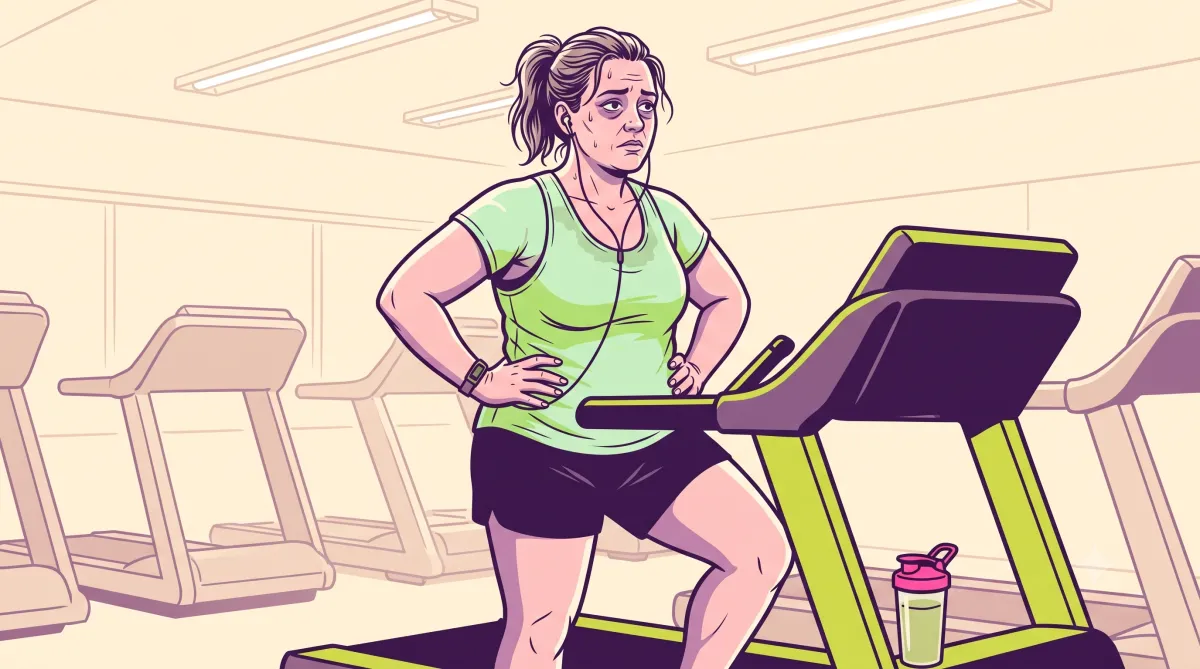
Why Does Exercising Harder Make My Perimenopause Symptoms Worse?
Short answer up front: because harder isn't what your body is short of right now. Your body's short of recovery, and the harder sessions you're adding are spending the one resource you don't have spare — cortisol capacity.
I'm 55. I've been a fitness professional for over 30 years, and I lost five stone of my own body weight during perimenopause, using the same approach I now build into Body Reclaim. So when a client tells me she's added two extra HIIT sessions a week because the scale stopped moving, and three months later she's heavier, more inflamed, and sleeping worse — I'm not guessing at what's happening. I've watched this pattern in over 200 clients, and I lived it myself first.
Here's the direct answer: pushing harder when your hormones are already in flux raises cortisol on top of a baseline that's already elevated and slower to recover. Your body reads that extra training load as a threat, not a goal. It responds by holding onto fat around your middle, increasing your appetite, and disrupting your sleep — which then makes you more tired, so you either push harder again or stop altogether. That's the trap. Not a willpower problem. A stress hormone responding exactly as it's designed to.
This is the part almost nobody explains to women in perimenopause: the rules that worked in your 20s and 30s — eat less, move more, when in doubt do more — actively work against you now. More effort, applied to a system that's already maxed out, doesn't get you further. It gets you stuck, then worse.
Key Takeaways
Harder training when cortisol is already elevated doesn't accelerate results — it accelerates the very symptoms you're training to fix.
Visceral fat (the stubborn belly kind) has roughly four times more cortisol receptors than fat stored elsewhere, so excess cortisol gets stored exactly where you don't want it.
Caloric restriction and high-intensity exercise both raise cortisol independently — stack them together during perimenopause and you compound the problem.
The fix isn't less effort or more effort. It's the order you apply it in, plus a recovery floor most fitness advice skips entirely.
Clients who stop trying harder and start fixing the underlying system see fat loss and energy return as a side effect, not the goal.
The Problem
Most of the women I work with arrive having already done everything "right" by the old rulebook. A personal trainer. A diet club. Maybe a GLP-1 prescription, or HRT handed over with no other guidance attached. Some have been told by a GP that what they're feeling is just stress, or low mood, and sent away with antidepressants instead of an actual look at what's going on in their body.
None of that is poor judgement on their part. It's that every one of those interventions patches a single hole in a bucket that's leaking from six places at once. HRT might steady hormones. A diet club might cut calories. None of them touch cortisol — and in a lot of cases, the calorie cut and the extra spin class actively make the cortisol problem worse while the hormone patch is trying to help.
The pattern I see constantly: a woman notices her body isn't responding the way it used to. Her instinct — a reasonable one, built over decades of "more effort equals more results" — is to add. Add a session. Cut more food. Get up earlier to fit in a run before work. For years before perimenopause, this worked. That's exactly why it's so disorienting when it stops.
What's actually happening underneath: perimenopausal women tend to run a higher baseline cortisol and recover from cortisol spikes more slowly than they did before. Add intense training and a calorie deficit on top of a system that's already running hot, and you're not asking for more output. You're asking an already-strained system to absorb more stress, with less spare capacity to deal with it.
The result isn't dramatic. It's slow. Weight that sits stubbornly around the middle. Sleep that gets lighter and more broken. A short fuse by 4pm. Training sessions that used to leave her energised now leave her flattened for two days. None of it on its own seems alarming enough to question the "try harder" plan — which is exactly how it goes unaddressed for years.
The Evidence
This isn't a feeling I have about my clients. It's a pattern, and the research backs the mechanism even where it doesn't always use the word "perimenopause."
Visceral fat — the fat that sits around the middle and behind the abdominal wall — carries roughly four times the density of cortisol receptors compared with fat stored elsewhere on the body. When cortisol rises, that's where the body is biologically wired to store it. So a training plan that spikes cortisol isn't neutral on belly fat. It's actively directing fat there.
Cortisol also raises ghrelin, the hormone that drives hunger, and it increases insulin release, which favours fat storage over fat use. So the woman who's pushing harder and eating less often finds herself hungrier, not less hungry — and more of what she does eat gets stored rather than burned. That's not a discipline problem. It's the hormone doing exactly what it's built to do under perceived threat.
The exercise piece matters specifically because both halves of the "try harder" instinct raise cortisol independently. Caloric restriction raises it. High-intensity training raises it. Combine the two — which is precisely what most fat-loss advice tells a woman to do — and you're not getting double the result. You're getting compounded hormonal load on a system with less capacity to clear it, because the perimenopausal stress-response system is already running closer to its ceiling.
What the research also shows is the way out: moderate-intensity aerobic work combined with two to three resistance sessions a week — not five HIIT classes — produced the biggest improvements in cortisol regulation, sleep quality, mood, and symptom frequency among perimenopausal women studied. Less, applied with more intention, outperformed more.
I've watched this exact pattern across the 200-plus women I've coached through Body Reclaim. The ones who drop the extra sessions and add the recovery layer first are, almost without exception, the ones whose body composition starts shifting again — usually within weeks, not months. Not because they're working harder. Because they've stopped fighting their own stress hormone.
The Solution
This is the part where I tell you the fix isn't a new app, more willpower, or another supplement stacked on top of the ones you're already taking. It's an order of operations.
The Compound Method™ — the system Body Reclaim is built on — exists because I had to solve this on my own body first, at 55, with thirty-plus years of fitness knowledge that turned out to need a complete rebuild for this phase of life. The principle underneath it is Fix the Leak: you don't patch each symptom (the belly fat, the sleep, the energy, the mood) one at a time. You fix the system underneath all of them, in an order that doesn't spike the very hormone causing the problem.
In practice, that means cortisol gets addressed before training intensity goes up, not after. A woman who's exhausted doesn't get handed a harder programme — she gets handed a recovery floor first: sleep non-negotiables, protein and blood sugar steadied, nervous system signals brought down from "threat" to "safe." Only once that foundation is in place does training load increase, and even then it increases as resistance work and brisk movement, not back-to-back high-intensity sessions stacked on a deficit.
This is the bit that surprises almost every client: results show up faster once they stop trying so hard, not slower. Energy comes back first — usually within one to two weeks — because that's the most immediate signal the nervous system is no longer being treated as under attack. Fat loss, strength, and the rest of it follow as a consequence of that recovered capacity, not as something chased directly.
None of this means doing less work forever. It means doing the right work, in the right order, so that effort actually lands instead of being absorbed by a stress response. Most women who come to me have spent years assuming more effort was always the answer because it used to be. The hardest part of Body Reclaim, for most clients, isn't the training. It's giving themselves permission to do less of the wrong thing first.
This is also exactly why diet clubs, generic PT programmes and menopause supplements taken in isolation tend to plateau or backfire — they're built on a pre-perimenopause assumption that effort and deficit always equal progress. Body Reclaim is built on the system as it actually behaves at this stage of life, not the one from a decade ago.
FAQ
Will doing less exercise really help me lose weight in perimenopause?
Yes, if what you're currently doing is high-intensity and stacked on a calorie deficit. Reducing intensity while increasing resistance training and recovery lowers cortisol, which is often the actual block on fat loss — not a lack of effort or discipline on your part.
How do I know if cortisol, not calories, is my problem?
Look for the pattern: stubborn middle-body fat despite a deficit, broken sleep, afternoon energy crashes, and feeling worse after intense sessions rather than better. If that's familiar, cortisol regulation needs addressing before training intensity does.
Should I just stop exercising altogether until this resolves?
No. Movement still matters — brisk walking and resistance training actively support lower cortisol over time. The shift is away from frequent high-intensity sessions stacked on restriction, not away from exercise itself.
Can HRT fix this on its own?
HRT addresses hormone levels, not cortisol caused by training and diet patterns. Many women on HRT still run high-intensity routines and large deficits and wonder why symptoms persist — the lifestyle layer underneath still needs its own attention.
How long before I'd notice a difference if I changed my approach?
Most Body Reclaim clients report energy and sleep improving within one to two weeks of lowering training intensity and steadying recovery. Fat loss and strength changes typically follow over the following four to eight weeks.
Conclusion
You don't need another plan that tells you to push harder. You've already proved you can push harder — that's not in question, and it's not what's missing.
What's missing is someone telling you the truth your body's been trying to tell you for months: it's not asking for more. It's asking you to stop fighting it long enough to let it work again.
I'm not going to pretend that's an easy sell to a woman who's spent twenty years believing effort is the only lever she has. I get it — I believed it too, right up until my own body forced me to learn otherwise at 55. But the women who get the best results in Body Reclaim aren't the ones who try the hardest. They're the ones who stop, fix the leak underneath, and let the rest follow.
If you're tired of patching symptoms one at a time, look at Body Reclaim and The Compound Method™ — and start with the system, not another session.
Your body was never the problem. The plan was.
Jane Cox is a fitness professional with over 30 years' experience and the founder of Body Reclaim. She lost five stone of her own body weight during perimenopause and built The Compound Method™ from what actually worked on her own body first.