A Few Simple Ways to Stay Consistent Without Relying on Motivation
You were motivated on Monday.
Genuinely, properly motivated. Kit laid out. Meals sorted. Alarm set.
By Thursday, that version of you felt like a stranger.
If this sounds familiar, I want you to hear something: that is not a character flaw. That is just what motivation does. It rises and it falls. It responds to your sleep, your stress, your hormones, your workload.
And in perimenopause, when all of those things are shifting at once, motivation becomes more unreliable than ever.
The question is not how to get more of it.
The question is how to need less of it.
James Clear, author of Atomic Habits, puts it plainly: "You do not rise to the level of your goals. You fall to the level of your systems." Motivation gets you started. Systems are what keep you going when motivation has gone home.
Consistency is not a personality trait. It is a design problem. The women who stay consistent longest are not the ones with the most drive. They are the ones who have removed as many decisions as possible, lowered the bar to start, and made the habit easier to do than to skip.
Here is how to do the same.
Key Takeaways
Consistency is a design problem, not a willpower problem
Deciding in advance removes the need to feel motivated in the moment
Making the habit smaller makes it easier to start on the hardest days
Your environment does more work than your effort
One habit, done reliably, beats ten habits done occasionally
Make the decision before your tired brain has to
Research by psychologist Peter Gollwitzer found that when people decided in advance exactly when, where and how they would do something, they were far more likely to follow through.
Not because they were more motivated. Because they removed the decision.
Clear builds on this in Atomic Habits with what he calls implementation intentions: a simple plan that links a time and place to a behaviour.
"After I make my morning tea, I do ten minutes of movement." "After I finish work, I change into my kit." "On Tuesday, Thursday and Saturday, I train before I check my phone."
You are not waking up every morning and asking yourself "do I feel like it today?" You answered that question already, when you were calm and clear. When Thursday arrives, the answer is already done.
Write yours down. Be specific about the when and where. Then stop renegotiating it.
Lower the bar, not your standards
The biggest reason people stop is not that the habit is too hard.
It is that it is too big to start when they are tired.
Clear's Two-Minute Rule addresses this directly: when you start a new habit, it should take less than two minutes to do. Not because two minutes is the goal. Because starting is the hardest part, and a habit you actually do is worth more than a perfect plan you keep skipping.
An hour-long workout is easy to skip on a bad day. A 20-minute walk is much harder to argue yourself out of. And once you start, you might do more. But you started. That is the part that builds the habit.
Think about what the floor version of your habit looks like. Not the ideal version. Not what you would do on a perfect week. The minimum version. The one you will genuinely do when the week is difficult, the kids are loud and the energy is not there.
That is your actual habit. Build from there.
This is the thinking behind Body Reclaim. One habit. Easy enough to do today. Not an overhaul of everything at once. Just one little yes. You add the next one when the first one is no longer a question.
Set up your environment to do the work
Clear's first law of behaviour change is: make it obvious.
People are not primarily driven by intention. They are driven by what is visible, convenient and easy to reach. Which means your environment is doing more work than your willpower ever could.
In Atomic Habits, Clear talks about "environment design" — shaping the space around you so the right behaviour becomes the path of least resistance.
Practical version:
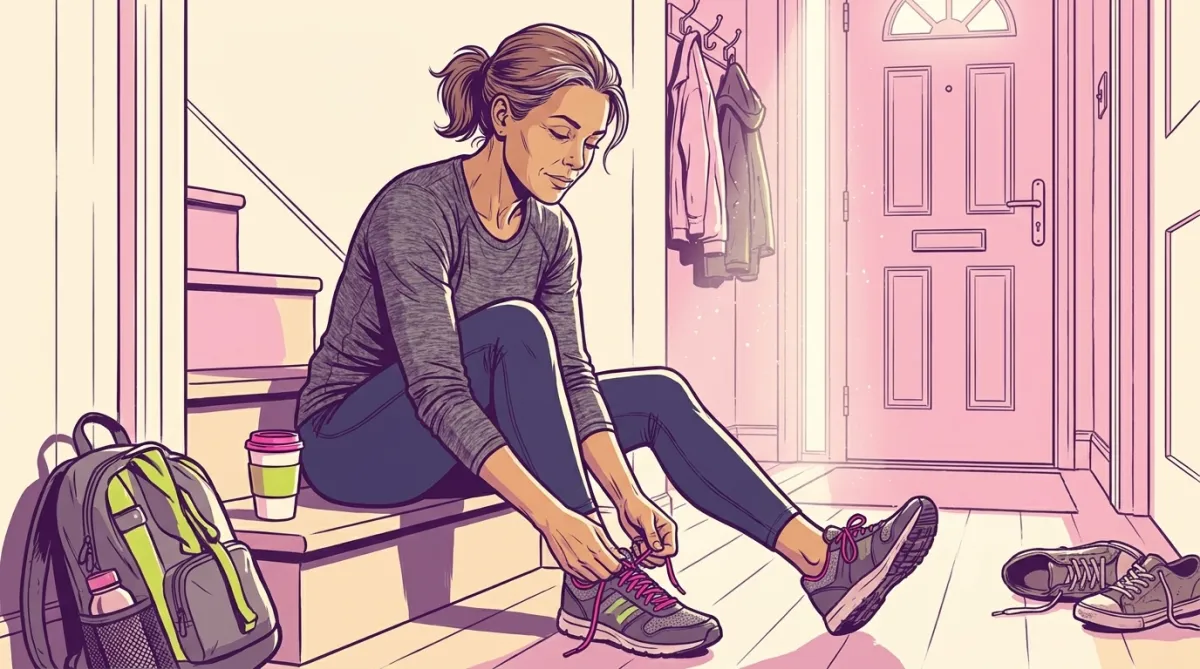
Lay your kit out the night before. Put your trainers by the door, not in the cupboard. Keep your protein ready in the fridge instead of something you have to make from scratch at 7am when you are already behind.
Remove the steps between you and the habit. Add steps between you and whatever competes with it.
You are not trying to have more discipline. You are trying to need less of it.
Attach the new habit to an old one
New habits need a place to live.
If you are trying to carve a new slot out of your day, you will probably fail. But if you borrow the slot from something that already happens reliably, the new habit has a home.
Clear calls this habit stacking. The formula is: "After I [current habit], I will [new habit]."
After I make my morning tea, I do five minutes of movement. After I sit down to work, I drink a glass of water. After I get home, I get changed before I sit down.
The existing habit cues the new one. Over time, the brain links them. It starts to feel odd not to do the second one when the first is done.
Choose one habit you want to build. Find something you already do every day without thinking. Attach the new habit right after it. Then do it for four weeks before you add anything else.
One habit, done reliably, is worth more than ten done occasionally
The last thing, and I think it matters most.
Clear is clear on this: it is not about any single action. It is about who you are becoming through the accumulation of small repeated choices. Every time you show up, you cast a vote for the person you are deciding to be.
Most women do not give up because they lack discipline. They give up because they took on too much at once.
Ten new habits in January. Eight dropped by February. All or nothing by March.
Clear's rule for when you miss: never miss twice. One missed day is an accident. Two missed days is the start of a new habit — the habit of not doing it. The goal is not perfection. It is getting back to it before the gap becomes the pattern.
Choose one habit. Do it until it feels automatic. Then add the next one.
That is the Compound Method. That is how small, repeated action becomes the kind of change that is still there a year from now.
Conclusion
Motivation will come and go. Some days it shows up before your alarm. Some days it does not come at all.
That is fine, because you are not building your consistency on motivation.
You are building it on a decision made in advance, a habit small enough to start, and an environment that makes it easier to go than to stop. Clear calls this the system. I call it the only thing that actually works when life is full and energy is low.
That is a much more reliable foundation than waiting to feel ready.
FAQ
How long does it take for a habit to become automatic? Research suggests somewhere between 18 and 254 days, depending on the habit and the person. The average is around 66 days. Clear is honest about this in Atomic Habits — there is no magic number. The point is to keep the habit small enough to repeat every single day until it stops being a question.
What if I miss a day? Miss one day. Never miss two. Clear's rule, and it is a good one. One miss is a blip. Two misses is the start of a new habit — the habit of not doing it. Get back to it the next day. That is the whole recovery plan.
I've tried and failed multiple times. Does any of this actually work? Yes. Most failed attempts come from the plan being too big, not from the person being too weak. Clear calls this "the plateau of latent potential" — results come later than effort, and most people quit before the results show up. Shrink the habit first. Then build.
Is this especially relevant in perimenopause? Particularly relevant. Hormonal fluctuation in perimenopause makes motivation more variable than at any other time in your life. This is exactly when to stop relying on how you feel and start relying on structure instead. The body is not broken. The plan just needs to fit the season you are actually in.
What one habit would you start with? Something you can do in ten minutes or less, at the same time every day, attached to something you already do. Movement, protein, sleep — whichever of those three is furthest from where you want it to be. Start there. One little yes. Then the next one.
Body Reclaim is a structured 12-week program built around exactly this approach, one habit in the right order at the right time.